

Verity Den don’t do things by halves. Just over 18 months since their excellent self-titled debut LP and the subsequent run of shows which saw them share the stage with the likes of Merge Records favourite, Rosali, and Australian mutant rock behemoth, Tropical Fuck Storm, the Carrboro, North Carolina four-piece return with their much-anticipated follow-up, Wet Glass.
On Wet Glass, Verity Den make even greater strides in their quest to draw from new places. The core line-up of Casey Proctor, Mike Wallace and Trevor Reece, now joined by fourth member, Reed Benjamin, who has been a part of the band’s live set-up since the release of Verity Den, and it’s this continuity that has galvanised the band.
From the off, Verity Den’s shape-shifting qualities are evident on Wet Glass – the fuzz-laden dream-gaze of Vacant Lot, melting time as pink noise litters the sky. In trademark fashion, Verity Den don’t stay in one place for long, and the chiming, diesel-powered chug of the title track sees to that, as Proctor and Reece effortlessly trade verses through seamless songcraft. It continues later on the album, too, with album highlight, Green Drag – this time Proctor being flanked by Wallace, and the results are one of a kind.
Wallace has his own moment to shine throughout Wet Glass. On Spit Red, his knife-sharp wordplay turns on a dime in what is the kind of street-level poetry that could be illuminated on the spoken word circuit. Elsewhere, the gliding, multi-layered Unsolved Mystery underlines Benjamin’s importance to this latest manifestation of the band, adding vital new components to this already well-oiled machine.
Which is ultimately navigated by Proctor. Her performance, whimsical and spectre-like, led by the slow jam, Push Down Hard / Tess II. A song broken into two parts, it sees Verity Den moving into yet another new corner of their sound world. So, too, with Sympathizer – a combat of mess and noise that sees the band at their most untethered.
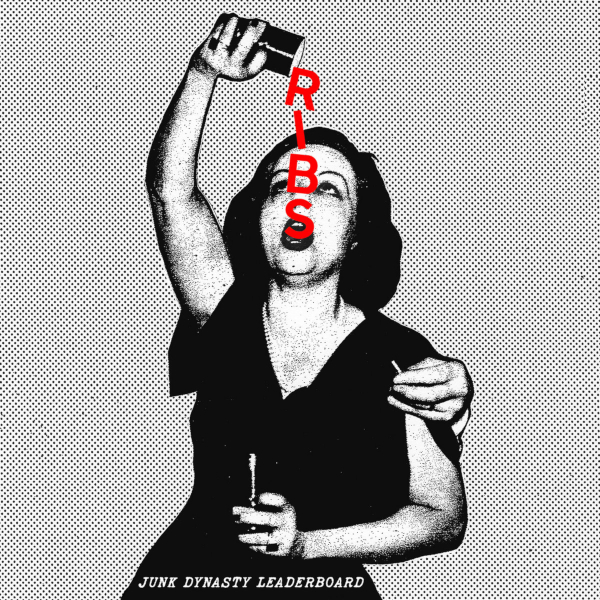
It’s these sudden shifts and split-personality-like moments that make Wet Glass what it is. Each member drawing from their own experiences beyond Verity Den (Proctor, last year releasing her own self-titled LP under the excellent Haruspex Palace project, while earlier this year Wallace led RIBS to glory with their debut LP, Junkyard Dynasty Leaderboard before he and Reece spent years trading barbs as Drag Sounds).
It’s this residue that drips into the Verity Den aesthetic. A creative synergy where trust and agility conquer, and Wet Glass is testament to that, resulting in one of the most forward-thinking guitar-based albums released this year.
To coincide with today’s release of Wet Glass, Proctor and Reece share their thoughts on each song and the processes behind them.
S13: It’s been a busy 18 months for the band. Speaking to you last year, and those tracks were written some time ago…what was the writing and recording process for Wet Glass?
Casey Proctor: “This time around we did things a little differently. Some of the songs we began demoing while the first record was coming out, and some of it was written after the bulk of the record was finished – the instrumental songs were the last addition. Trevor recorded some of it at his home studio – like Vacant Lot and Unsolved Mystery were songs he already had recorded – then we just layered some vocals, guitars and synths on top. Unlike the first record, some of the songs on this one have real drums – all recorded by Reed at his studio. Most of the rest of it was recorded at my place.”
S13: Vacant Lot has so much going on underneath the mix. It feels like it occupies the space between AM and FM radio. Was it an easy choice as the opening song?
CP: “I think the reason we put that one first is because it sounds kind of like it could have been on the first record. It pulls a line through, then the further you get into this LP the more the sound evolves into some newer things we’ve been experimenting with. The textures from the first record are still all over Wet Glass but there’s a lot more going on from song to song. Also, some people may notice that the vinyl master is different from the digital master – when you play the actual record the songs will run together seamlessly, but the digital files are edited as individual songs if that makes sense. Just a special experience for those that buy a physical copy of Wet Glass.”
S13: The title track and Green Drag are the two songs in which the lead vocals are shared with you, Casey – firstly alongside Trevor, then with Mike. Was the genesis of these songs worked on together in real time or are you all bringing in different ideas then merging them together?
CP: “Both of those songs were written as a band in a room. I think we wrote most of the music first, then I remember coming up with chorus vocals – for both songs. I sometimes dread writing verses, and the guys are really good at it so it’s a thing we do. Trevor and I worked through the verse vocals on the title track Wet Glass together in one evening… and Mike brought verse vocals in for Green Drag.”

Verity DenS13: Unsolved Mystery has a beautiful piano line running underneath the mix. It really encapsulates the meticulousness of Wet Glass’ production, and its new added layers. How vital was Reed’s inclusion to the band this time around?
CP: “Reed is all over this LP, either playing drums or synth, and piano at the end of Sympathizer. He programmed some really vibey ambient loops that are on Push Down Hard and All It Was. The piano for Unsolved Mystery I recorded on my upright Samick at home – we have a couple pianos at hand, so they make a few appearances on the record.”
S13: Spit Red really feels like Mike has the flow after RIBS’ Junkyard Dynasty Leaderboard was released earlier this year. What were the key inspirations behind this song?
Trevor Reece: “The original guitar-only demo for Spit [Red] sat on the shelf for maybe a year before we decided to try it out as a group. Sometimes I don’t want to sing or write the lyrics (that doesn’t always work out for me!). Mike willingly stepped up on lead for Spit Red and Green Drag thankfully… I think at this point we can feel out what song fits who on vocals or if it wants to be instrumental without too much discussion. Maybe that’s the Drag Sounds dynamic still hanging around. I’ll have an idea for a song, record a demo and fire it off to the group to shape together. Mike has developed a style of writing lyrics and choosing his delivery in a way that we like and can agree on. We have work to do and if we like the way a song is moving, we choose to move with it.”
CP: “Yeah, Mike has always had the flow.”
S13: Perhaps a question within a question… firstly were Push Down Hard / Tess II originally intended to form as one song? If not,was Tess II written closely with Tess from your first record?
CP: “They were not originally connected. Push Down Hard was already recorded, and Trevor and I were writing / recording some ideas for the instrumental songs during the last phase of making the record. Tess II manifested similarly to Tess in that we were just sitting in a room playing some guitars – Tess was recorded with one mic in a room with three acoustic guitars playing – so it had the same kind of improvised feel. I think the decision to attach it to the end of Push Down Hard came instinctually. Like, sometimes you’re not ready for a song to end but you also don’t want to keep playing the same thing, so you smash two songs together, whether they like it or not.”

Verity Den - Wet GlassS13: The abstract nature of the song feels closely aligned to Wet Glass’ artwork, which Michael Vallera is responsible for. Judging by his own work, it feels like both your visions run pretty closely with each other…
CP: “Yeah, Mike V has been awesome to work on art design for the first record and this one. I’m definitely into his delivery of geometric / minimalist / abstract imagery and some of that aligns with our stuff, for sure. The cover image was snapped by myself, and the inner sleeve and B-side of the centre label feature our friend Richard Stilwell’s art. He has some secret process for damaging slide film in very particular ways, and it turns up looking very cool. All together it’s really up to interpretation, but this album’s artwork reminds me of some magical and delirious nights I’ve had driving around in the dark woods, if you know what I mean.”
S13: Tess II runs beautifully into All it Was. Your instrumentals feel like vital parts in contextualising the Verity Den experience. Do you see it the same way?
CP: “We spend a lot of time just playing without vocals, especially after we’ve taken a break and it’s been a while since we’ve been in a room together. It feels really good to do – vocals are such a guide and without them it’s really fun to get lost in whatever world we’re creating. So it has become a very important part of writing and performing live.”

Verity DenS13: Sympathizer stands on its own; maybe even as an outlier track on the record, with you singing over a dissonant wall of noise? How did this song come about?
CP: “It started as a one note synth loop, and a programmed drum beat Trevor and I had been messing around with. I recorded the vocals when I was in a weird mood one night and sent it to the guys as a kind of non-serious thing, but we ended up filling out the song eventually. It’s mostly just written from the perspective of having social anxiety and exhaustion as an introvert, which is a pretty trivial thing to meditate on when there are so many terrible things happening in the world. Not taking myself too seriously helps me keep my feet on the ground, so I put a lot of that in my lyrics.”
S13: To Trees feels like a nod to the environment.Open space is something I associate closely with your music. Does the environment and vastness influence your work?
CP: “Absolutely. I think we are all inspired by the expanse of the natural world, as well as our complicated relationship to it as humans. To Trees addresses the fragility of human life and the fact that we can’t exist without certain things that we generally take for granted. I love the idea that if humans were to disappear, everything would survive, or thrive, without us.”
S13: Highway Fifty Four is another instrumental that has real emotional weight to it. Ending the record that way seems like you’re travelling into the unknown and is an apt way to end the record, as Verity Den’s music evokes a certain kind of escapism. Was this the intention?
CP: “If the songs invite people to escape to other realities or offer some sort of reprieve – that’s awesome. I hope they can do that for the listener. To me, the songs are an interpretation of reality, not a made-up fantasy world. That sense of the unknown is far from avoidant in that there’s an exploratory mindset. It’s more like revisiting your childhood home or seeing the streets of Florence for the first time. When we play the songs live, there’s an opportunity to essentially show the audience around the song we built. Interpreters can be literal or poetic, but they are essentially describing the same thing. So yes, always headed into the unknown, but not escaping from anything either.”
Wet Glass is out now via Amish Records. Purchase from Bandcamp.

3 replies on “Track By Track: Verity Den’s Wet Glass”
[…] Track By Track: Verity Den’s Wet Glass […]
[…] Track By Track: Verity Den’s Wet Glass […]
[…] Track By Track: Verity Den’s Wet Glass […]